
Intermediate Singing Lessons for Developing Vocalists
Personalized Intermediate Singing Lessons
Intermediate singing lessons are for singers who already understand some of the basics but know there is more available in their voice. Maybe you can carry a tune, understand breath support, and have taken lessons before, but certain parts of your range still feel inconsistent, your technique falls apart under pressure, or you are ready to move beyond simply singing songs correctly.
At the intermediate level, lessons become less about introducing the fundamentals and more about refining how you use them. We can work on range, register transitions, tone, stamina, phrasing, vocal health, performance, harmony, artistry, and the specific technical patterns that may be keeping your voice from feeling as reliable or expressive as you want it to.
Note to Intermediate Singers
Reaching an intermediate level can be exciting and frustrating at the same time.
You know enough to hear when something is not working, but you may not always know how to fix it. A note that felt easy yesterday may feel difficult today, your upper range may be inconsistent, or you may understand a technique intellectually without being able to reproduce it reliably in a song.
This is where more detailed coaching becomes valuable. Intermediate singing lessons help you turn partial understanding into greater consistency so your technique becomes something you can actually depend on.
What You Can Build Through Intermediate Singing Lessons
Greater Consistency Across Your Range
Intermediate singers often have strong areas of the voice and less dependable ones. Lessons can help you smooth out those differences, strengthen transitions, and make more of your range usable without feeling like every song requires a different strategy.

Better Control of Tone, Breath, and Dynamics
Once the fundamentals are in place, you can begin making more intentional choices. Intermediate singing lessons can help you develop finer control over breath, tone, volume, resonance, phrasing, and dynamics so your voice responds more predictably.

Stronger Vocal Stamina and Health
As songs become more demanding, stamina matters more. We can look at where unnecessary effort or tension may be causing fatigue and build more efficient habits that support rehearsals, performances, and longer periods of singing.

More Distinct Artistry and Musical Expression
Intermediate work is not only about fixing technique. It is also about discovering how you want to sound. Lessons can include interpretation, phrasing, stylistic choices, improvisation, harmony, songwriting, and the creative decisions that help your voice feel more individual.
Intermediate Voice Lesson Options

Introductory Intermediate Voice Lesson
Your introductory lesson gives us a chance to identify where your technique is already working well and where you may be getting stuck. We can talk through your experience, musical goals, repertoire, and any recurring challenges you have noticed.
This creates a clearer starting point for intermediate singing lessons that build on what you already know rather than starting over from the beginning.
Ongoing Intermediate Singing Lessons
Regular lessons give you time to refine technique, work through more complex vocal challenges, and apply new skills consistently to songs. Depending on your goals, we can focus on range, tone, register transitions, vocal stamina, performance, artistry, songwriting, or other areas as they develop.

Voice Lessons + Expression Sessions
Some intermediate singers reach a point where the next obstacle is not entirely technical. Perfectionism, performance anxiety, fear of being heard, or difficulty expressing emotion can begin limiting what happens even when the vocal mechanics are improving.
Voice lessons can be paired with Expression Sessions when you want additional space to explore those deeper patterns alongside your technical work.
Choose Between Private or Group Intermediate Singing Lessons

Private Intermediate Singing Lessons
Private intermediate singing lessons give you dedicated time to focus on the specific areas that are keeping your voice from feeling as consistent or flexible as you want. Sessions can target register transitions, range, tone, stamina, breath coordination, vocal health, phrasing, performance, or any recurring challenge that needs more individualized attention.
One-on-one coaching can be especially useful when you have already built a solid foundation but feel stuck at a plateau. With more detailed feedback, you can identify the habits behind that plateau, refine your technique, and develop a clearer understanding of how to troubleshoot your own voice as you continue progressing.
Group Intermediate Singing Lessons
Group lessons give intermediate singers a chance to apply stronger technique in a more collaborative environment. Singing with other people can help develop harmony, blend, timing, musical responsiveness, and the ability to hold your own part while listening closely to the voices around you.
This format can also be valuable for building performance confidence and adaptability. Intermediate singers often know what they want to do technically, but group work challenges them to maintain those skills while responding to other musicians in real time. That combination can make group lessons a useful complement to private coaching.

Intermediate singers often benefit from both focused one-on-one coaching and opportunities to apply their skills around other voices. Private lessons can help you refine specific technical challenges, while group work can strengthen harmony, listening, confidence, and the ability to stay consistent in a more dynamic musical setting.

How to Get Started With Intermediate Singing Lessons
Getting started begins with an introductory call so I can learn more about your experience, what kind of training you have already had, and what currently feels frustrating or incomplete. From there, we can begin with an introductory session and identify the technical and artistic areas most likely to move your voice forward.
You do not need to know exactly why something is not working. Maybe you feel stuck at the same range, tire during longer songs, lose control when you sing loudly, or struggle to reproduce your best sound consistently. Intermediate singing lessons can help identify what is actually happening and give you a clearer path forward.
Meet Your Intermediate Vocal Coach
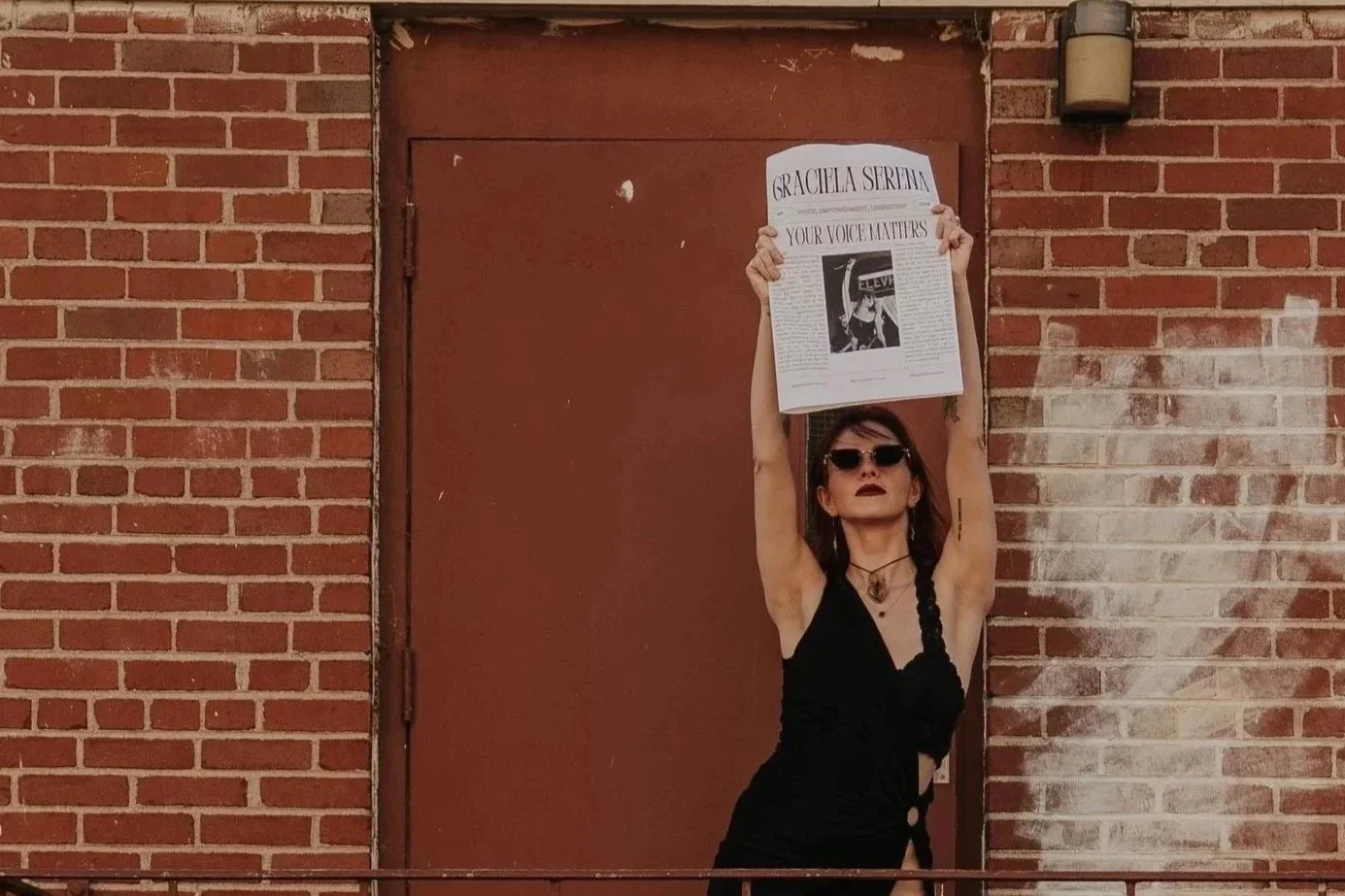
Graciela Serena
I bring together vocal mentorship, songwriting, performance experience, creativity, and expression coaching to help singers develop a healthier and more authentic relationship with their voice. With intermediate singers, the work often becomes more detailed because you already have enough experience to notice nuance and begin making more intentional choices.
My goal is not to tear down everything you have already learned. It is to identify what is working, strengthen what is inconsistent, and help you become more independent in understanding your own instrument.
As your voice becomes more reliable, we can also go deeper into artistry, performance, songwriting, emotional expression, and the choices that help you sound increasingly like yourself.

How Intermediate Singing Lessons Take Your Voice to the Next Level
-
When progress slows down, repeating the same exercises harder is rarely the answer.
Intermediate singing lessons can help identify the specific habits affecting your voice, whether that is excess tension, inconsistent breath, register imbalance, resonance choices, or difficulty transferring technique into songs.
Once the actual pattern becomes clearer, practice becomes much more targeted.
-
Intermediate vocal training can help different parts of your voice work together more smoothly. Instead of feeling like you have several disconnected voices, we can work toward greater flexibility between registers, dynamics, pitches, and tonal qualities.
That coordination can make your range feel more reliable and reduce the need to compensate by pushing or backing away from difficult notes.
-
Once you are not thinking about every technical detail, more attention becomes available for music.
We can work on phrasing, dynamics, emotional arc, articulation, timing, stylistic choices, and the subtle decisions that help a performance communicate something beyond the notes themselves.
This is often where intermediate singers begin sounding less like students and more like artists.
-
The more you sing, rehearse, or perform, the more important efficiency becomes.
Intermediate singing lessons can help you develop the stamina to handle longer songs, rehearsals, and performances without feeling like your voice disappears halfway through. The focus is on sustainable coordination rather than simply enduring more strain.
-
One of the goals of intermediate training is learning how to troubleshoot your own voice.
You can begin recognizing when tension is appearing, why a passage feels difficult, how to adjust your warm-up, and which exercises are useful for the problem in front of you.
That independence helps you practice more intelligently and makes your progress less dependent on constantly being told what to do.

Expression Sessions + Intermediate Singing Lessons
These 90-minute sessions combine one hour of personalized vocal coaching with 30 minutes of deeper expression work. They can be especially useful for intermediate singers who have developed solid technical skills but still feel held back by perfectionism, performance anxiety, self-consciousness, or difficulty fully expressing emotion.
Alongside intermediate singing lessons, we can explore nervous system patterns, embodied expression, fear of being heard, old stories about your voice, and the emotional habits that may surface when you begin taking bigger creative risks.
The goal is to help your technical and expressive development grow together so your increasing vocal ability leads to greater freedom rather than more pressure.

“After not singing for two years, I started working with Graciela Serena and she opened up my voice as well as my heart! I'm a true believer in following your dreams, but I had almost given up. She encouraged me and challenged me. She was like a gem digger who knew how to bring the beauty to the surface. I highly recommend her services!”
— KD Forrestal— Former Client
Your Questions About Intermediate Singing Lessons, Answered
-
Technical reliability creates more room for performance.
When you are less worried about whether you will hit the note, you can pay more attention to phrasing, dynamics, emotional connection, stage presence, microphone technique, and communication with an audience.
Intermediate singing lessons can help you practice those skills directly. If you are preparing for auditions, open mics, recordings, shows, or band performances, lessons can also be shaped around the specific demands of that situation.
-
Yes, but the exercises can become more targeted.
Rather than doing the same warm-up every time simply because it is familiar, intermediate vocal training can use exercises designed around specific goals such as range, register transitions, resonance, flexibility, breath coordination, stamina, or tonal control.
The point of the exercise is always to create something you can eventually use in music. As you become more experienced, understanding why you are doing an exercise becomes increasingly important.
-
Absolutely. Intermediate singers are often at a great stage for integrating vocal development with songwriting because you have enough technical awareness to understand how melody, range, phrasing, and tone affect the songs you create.
We can work on how original melodies sit in your voice, where certain phrases may be unnecessarily difficult, and how vocal choices support the emotional intention of the song. If you sing while playing an instrument, we can also work on coordinating both skills more comfortably.
-
Yes. Inconsistency is one of the most common reasons intermediate singers seek additional coaching.
You may occasionally produce the sound you want but struggle to understand why it worked. Intermediate singing lessons can help identify the coordination behind those successful moments so they become less accidental.
Over time, the goal is to make your best singing more repeatable. That does not mean your voice will feel identical every day, but you will have more tools for responding when something feels different.
-
Yes. Intermediate singers can work with me through in-person lessons in Asheville, NC or online vocal lessons from anywhere.
Both formats can support technique, range, register transitions, stamina, artistry, songwriting, performance, and other intermediate goals. In-person sessions also provide access to a studio environment where we can work with microphones and instruments, while online lessons offer additional flexibility for students who are not local.
-
There is no single test that determines whether you are an intermediate singer. You may be ready if you already have some control over pitch and breath, understand basic vocal concepts, have previous lesson experience, or can sing comfortably but keep running into recurring technical limitations. You may also simply feel that beginner material is no longer answering the questions you have.
Intermediate singing lessons meet you where you actually are rather than requiring a formal label. If some areas of your voice feel advanced while others still need foundational work, that is completely normal. The goal is to identify the next useful challenge rather than place you into a rigid category.
-
Beginner lessons generally spend more time introducing foundational skills such as breath, pitch, tone, range, vocal awareness, and basic practice habits. Intermediate singing lessons assume that at least some of those concepts are already familiar and begin refining how consistently you can use them.
At the intermediate level, there is usually more attention on register transitions, stamina, dynamics, range, stylistic choices, performance, interpretation, and applying technique to more demanding music. The work becomes more nuanced because you have a stronger foundation to build on.
-
Progress tends to feel dramatic when you are first learning because many concepts are completely new. Once the basics become familiar, improvement can become more subtle.
Intermediate singers may also encounter habits that worked well enough at easier levels but begin causing problems with higher notes, longer songs, more demanding dynamics, or performance situations. Intermediate singing lessons help identify those limitations so you can develop more efficient strategies instead of simply repeating what used to work.
-
Yes. Range development is often a major focus for intermediate singers because you already have enough coordination to begin exploring the edges of your instrument more intentionally.
The focus should not be simply reaching the highest or lowest possible note. Intermediate singing lessons can help make more of your range comfortable, consistent, and musically useful by working on breath, resonance, register transitions, tension, and vocal coordination.
-
Yes. Register transitions are one of the most common challenges at the intermediate level. You may notice a crack, sudden change in tone, loss of volume, or urge to push as you move through certain areas of your range.
Intermediate singing lessons can help you understand what is happening in those transitions and develop more flexible coordination. The goal is not necessarily to make every register sound identical, but to give you more control over how you move between them.
Book Intermediate Singing Lessons Today!
If you already understand the basics but feel like your voice has reached a plateau, intermediate singing lessons can help you identify what is holding you back and turn the skills you already have into something more consistent, flexible, and expressive.
Book an introductory call to refine your technique, expand your usable range, strengthen your performance skills, and take the next step toward a voice that feels increasingly reliable and authentically yours.